
When is a system sustainable?
... and why it all comes down to balancing it

I come across many different uses and meanings of the word sustainability these days, which makes me wonder whether I actually understand what it means to me. I guess I'd better make sure it does if that's supposed to be a key part of my mission for the next couple decades.
In general terms, sustainability is for a system to endure over time without self-depletion. There's two issues with such a definition. Firstly, the timeframe depends on the viewers perception. That makes it difficult to judge whether something is sustainable. It may be for 100 years - but will it be for 100 million years, or forever? A philosophical question which I would answer with "it depends". It depend on the second issue: how you define the system. If the system is planet earth, which is 4.5 billion years old, a reference frame of 10 billion years seems reasonable to me. If the system is our society, probably 1'000 years is a long time already. But that second point has another, much bigger implication. The boundaries of a system are easier to define in theory than in practice. There is hardly a clear cut between one system and another, or its environment. Even the boundaries of our planet and the outer space are fluid.
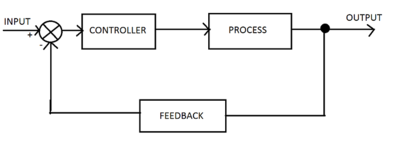 However, as economists we like to simplify things. And as engineer I like graphical illustrations, like the one of a control system. Leaving the two issues above aside for a moment, in essence for a closed system to be sustainable is for its output to be used as its input. There's two implications in this statement. On the one hand can there be no waste in the process, but actually preferably the output would be higher than the input. On the other hand, output and input would need to be identical. That's basically the definition of a perpetuum mobile.
Does that mean, sustainability is a myth? I guess technically it is. Does that mean we should stop caring? No, definitely not. The concept of input and output does give us a tool to assess our behaviour. The imbalance of what we're using as input into our system versus what output we can reuse as input in the next cycle is currently enormous. It is in fact so big, that we are depleting resources at an unprecedented level - and this is not only true for oil. The UN estimates that by 2025 about 1.8 bn people will live in regions with absolute water scarcity and other researchers predict that we will run out of phosphorus (a key element for plants to grow) in 50 - 100 years.
While the perfect sustainability may be physically impossible to reach, we should at least aim to establish a better balance between our inputs and outputs. This means three things:
- We need to improve the efficiency of our processes and reduce waste,
- … we need to increase the amount of output recycled for input,
- … and lastly, we won't get around decreasing the amount of input we are firing the processes with
